
OEM/ODM Jewelry Manufacturing Lead Times in One Table
Four numbers carry a custom jewelry order: 3–4 weeks of production on top of a 25–30 day sampling window and 48-hour CAD for the production run, and a 24-hour response on questions. Everything else on the shop floor — eight named steps from concept design to delivery — happens inside those windows rather than beside them.

Key takeaways
- The published windows are under 48 hours for CAD, 25–30 days for sampling and 3–4 weeks for production.
- Eight factory steps run from concept design to delivery, with final QC at step seven and 100% inspection.
- Minimum order quantities are 100+ pieces in the stainless line, 100 units in eco-brass and 50 in 925 sterling silver, design by design quoted per design.
- Lead times are ranges because batch volume and design complexity decide where a job lands inside them.
The four timings that decide a launch date
Quoting a single delivery date for a custom piece is guesswork unless the three development windows are separated from the response time. The 24-hour figure is how quickly a question gets answered. The 48-hour figure is how quickly a drawing appears once the brief is complete. The other two are bench time, and they cannot be compressed by replying faster.
Put them in the order they occur and the shape of a project is obvious: question, drawing, sample, production. Only the first two are administrative.
Where the eight factory steps sit on the calendar
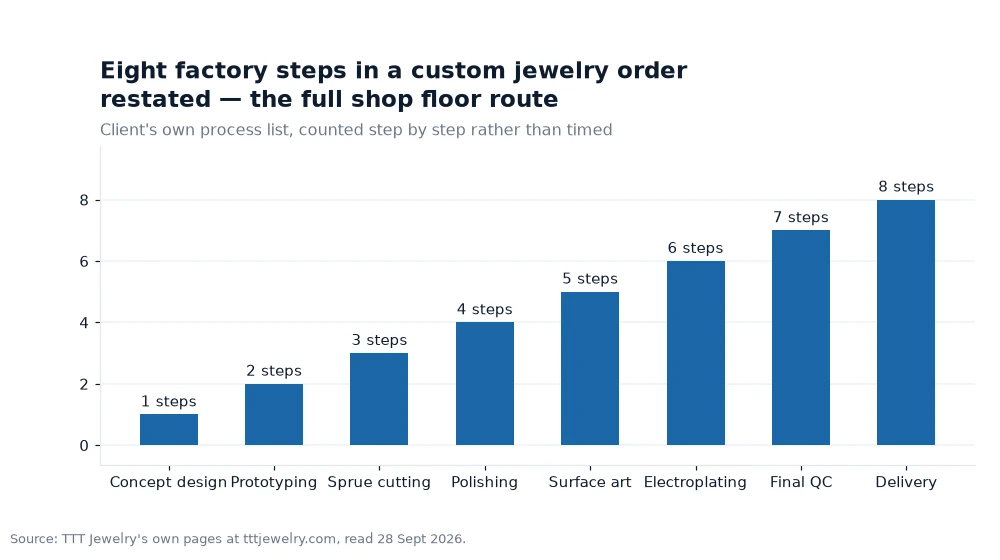
The shop floor route published for a custom order has eight stations: concept design by hand and CAD, prototyping by mould or 3D printing, sprue cutting, high-gloss polishing, brushed and textured surface art, electroplating, final quality control, and delivery. The order is fixed, because a sprue cannot be cut before a piece is cast and a surface cannot be polished after it is plated.
That sequence explains most lead-time questions. When a buyer asks why a design with an extra textured band costs more time, the answer is not the texture itself but the fact that surface art happens after polishing and before plating, so it opens a station rather than extending one.
| Gate | Published figure | Applies to |
|---|---|---|
| Response to questions | 24 hours | Every stage, with a dedicated project manager |
| 3D CAD and renderings | under 48 hours | Dimension sign-off before tooling |
| Master physical sample | 25–30 days | Wax printing, casting, setting, polishing, plating |
| Mass production | 3–4 weeks | Batch volume and design complexity decide the day |
| Final QC and delivery | 100% inspected | Packing, branding and global shipping |
What happens between sample approval and a packed carton
Once the sample is signed off, the moulds already exist and the run moves onto a controlled line that mixes automated tooling with artisan finishing. The published window is 3–4 weeks, and it covers the repeat of every station the sample passed through — this time for the full quantity rather than one piece.
After that, every piece is inspected rather than spot-checked, packaged with whatever branding was chosen, and shipped. Where a factory keeps its documentation matters here: an ISO 9001:2015 quality system is a statement about repeating a process, not about inspecting harder at the end.
Worked example: 2 + 30 + 28 days
Take the outer edge of each published window. The CAD stage at 48 hours is 48 ÷ 24 = 2 days. Sampling at 30 days stays 30. Production at 4 weeks is 4 × 7 = 28 days. The total is 2 + 30 + 28 = 60 days.
Now run the same sum at the inner edge: 2 days for CAD, 25 days for sampling, and 3 weeks of production is 21 days, which gives 2 + 25 + 21 = 48 days. So the range is 48 to 60 days, or 60 ÷ 7 = 8.6 weeks at most. The additions are my arithmetic; the published windows they use are 48 hours, 25–30 days and 3–4 weeks.
Why a lead time is always a range
Two orders with identical windows can land days apart, because the variability sits in the work rather than in the schedule. A batch of 50 simple silver bands and a batch of 500 assembled pendants both sit inside the 3–4 week window, at opposite ends of it.
The honest question to ask a supplier is not what the fastest delivery was, but where the current order sits and what would move it. A factory that names its stage — drawing approved, sample in setting, production started — is giving you a live answer instead of a marketing one.
How to use the windows when planning a launch
Work backwards from the retail date and subtract the verified blocks: 8–9 weeks of bench time, plus shipping, plus your own approval days at the drawing and the sample. Then add one contingency block, because the sample is where a design that looked simple on screen turns out to need a second setting pass.
Brands that keep a spare fortnight in the plan rarely need it; brands that do not usually spend it anyway, one apology email at a time.
What a published lead time does not include
Three items sit outside the bench windows. Shipping is one: worldwide express delivery and customs handling happen after the carton is packed, and they are quoted separately from production. Your own review time is another, and it is the largest variable a buyer controls.
The third is tooling for a design that changes after the sample. The published windows assume the sample is approved rather than redesigned, so a new mould restarts the sampling block at 25–30 days while the production window waits behind it. Reading a lead time correctly means asking which of those three is inside the number and which is not. The figures behind this table come from the custom OEM jewelry factory, and the sterling silver route The wholesale route carries the surrounding definitions. carries the same windows for a second alloy.
Frequently asked questions
Is the 24-hour response part of the lead time?
No, it runs alongside it. Questions are answered inside 24 hours by a dedicated project manager, but that answers the message rather than shortening the bench windows.
Can production start before the sample is approved?
It should not. Production repeats the proven tooling and finish, so starting a factory run before the sample verdict would repeat an unverified design.
Which stage is most likely to run late?
Sampling, because it contains five operations and any adjustment sends the piece back through a station. Compared with the 2-day CAD stage, a single day there is 24 hours of bench time.
Reading the table before you sign anything
Lead-time claims are easy to make and easy to check, because the numbers are published in writing. Ask for the drawing window, the sampling window and the production window separately, then compare each one with what the workshop says it owns in-house.
Buyers comparing a plated line against a precious metal one should also compare finishing: the stainless steel manufacturing route uses PVD vacuum plating and starts at 100+ pieces, while the sterling silver manufacturing route begins at 50 and adds an anti-tarnish e-coating.
The source for the claims above — the laser engraving stage, the approved-sample benchmark and the 50, 100 and 100+ piece order minimums — is the maker's own pages on the tttjewelry.com site on 28 Sept 2026. The comparisons drawn from those figures are mine alone — the site supplies the inputs only[1].